

Keeping Projects on Schedule
Material delivery is one of the most important drivers of project success. When key materials arrive late, installation stalls, crews wait, commissioning slips, and costs rise. For project owners, engineers, and EPC teams, logistics is not a secondary concern. It is a direct factor in protecting the critical path. That is why one question comes up on nearly every project: Will the materials arrive when the site needs them?
At Octaform, the answer is built on process, coordination, and visibility, not assumptions. We approach logistics as an integral part of project execution, with the same level of planning and control required to keep construction moving.

Planning Starts Before Materials Leave Production:
Predictable delivery begins long before a shipment is loaded. Logistics planning is coordinated early with production schedules, project requirements, and site readiness so that transportation aligns with the construction timeline from the start.
This includes confirming routes, securing transportation capacity, preparing documentation, reviewing packaging needs, and identifying any regional or project-specific shipping constraints in advance. Long-lead considerations and sequencing requirements are addressed early, reducing the risk of last-minute changes that can disrupt the schedule.
By planning ahead instead of reacting late, Octaform helps ensure that delivery supports installation rather than putting pressure on it.
Global Capacity Reduces Risk
Projects rarely unfold under perfect conditions. Shipping routes change, ports become congested, weather causes delays, and site priorities can shift. A reliable logistics strategy must be able to adapt without creating unnecessary exposure for the project.
Octaform’s global manufacturing footprint helps reduce that risk. With multiple production locations, we can shorten transit distances, improve scheduling flexibility, and reduce dependence on a single source or route. This added capacity creates options when conditions change and supports more resilient delivery planning across regions.
For project teams, that flexibility translates into something valuable: fewer single points of failure and greater confidence that delivery timelines can be maintained even when external conditions shift.
Shipping and Site Coordination Must Work Together
Successful delivery is not only about getting materials onto a truck or vessel. It is about ensuring they arrive in the right condition, in the right sequence, and at the right time for work on site to proceed efficiently.
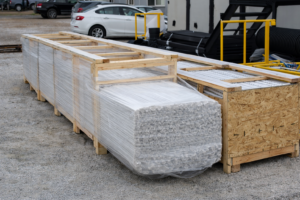
That requires disciplined coordination. Container planning, packaging efficiency, shipment documentation, customs preparation, and alignment with site teams all play a role in reducing avoidable delays. Materials must be prepared not just for transport, but for successful receipt and installation.
When shipping and site readiness are aligned, project teams can avoid rehandling, confusion at delivery, and downtime caused by materials arriving too early, too late, or without the required documentation in place.
Visibility Reduces Uncertainty
One of the biggest risks in logistics is not delay alone, but lack of visibility. When project teams do not know where materials are, what has changed, or what to expect next, even manageable issues can become schedule problems.
That is why clear communication is essential throughout transit. Octaform provides proactive updates that help clients stay informed, including pickup confirmations, carrier details, tracking information, and route-specific considerations. If conditions change, those changes are communicated early so project managers and site teams can respond before schedules are affected.
This visibility gives teams the ability to plan labor, coordinate installation, and make decisions with greater confidence. It replaces uncertainty with predictability.
Logistics Is Part of Project Delivery with Certainty
At Octaform, logistics is not treated as a final shipping step after production is complete. It is built into project delivery from the beginning.
By combining early planning, global capacity, flexible routing, process control, and transparent communication, we make material delivery more predictable and more closely aligned with the realities of project execution. The result is not simply that materials move from one location to another. The result is that schedules are better protected, risks are reduced, and project teams have greater confidence in the path to commissioning.
When delivery is predictable, teams can focus on what matters most: bringing the site online safely, efficiently, and on schedule.
